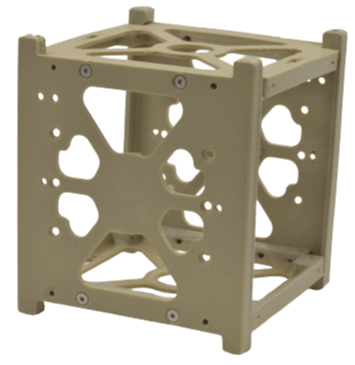
Polyether ether ketone (PEEK) is widely recognized as a premier thermoplastic candidate for replacing metal components in demanding aerospace and medical applications. With a melting temperature of 343° C and a glass transition temperature 143° C, PEEK offers chemical corrosion resistance, thermal stability, and a cortical bone-like elastic modulus.
Despite these material characteristics, achieving consistent mechanical properties along the vertical (ZX) axis in Fused Filament Fabrication (FFF) has historically presented significant engineering hurdles. Unoptimized processing can result in microscopic void formation and reduced interlayer adhesion, leading to mechanical anisotropy.
Understanding why this occurs requires examining the fundamental thermodynamics of convective ambient heating versus targeted radiative energy transfer.
The Thermodynamics of Convective Ambient Heating
Many high-temperature 3D printing architectures utilize convective heating to elevate the ambient air temperature inside the build chamber. In a purely convective system, thermal energy transfers from heating elements to circulating air, which subsequently heats the printed part.
While convective heating is effective for maintaining general environmental temperatures, it introduces specific physical constraints when processing high-temperature polymers:
-
Ambient Thermal Gradients: Air circulation within an enclosed volume inherently subjects the chamber to temperature variations, where regions near heating outlets differ in temperature from lower or central areas of the build volume.
- Surface Heat Loss at the Deposit Interface: Air has a relatively low heat capacity and heat transfer efficiency compared to direct radiation. As new filament is deposited, ambient air movement cools the upper boundary layer of the previously deposited bead.
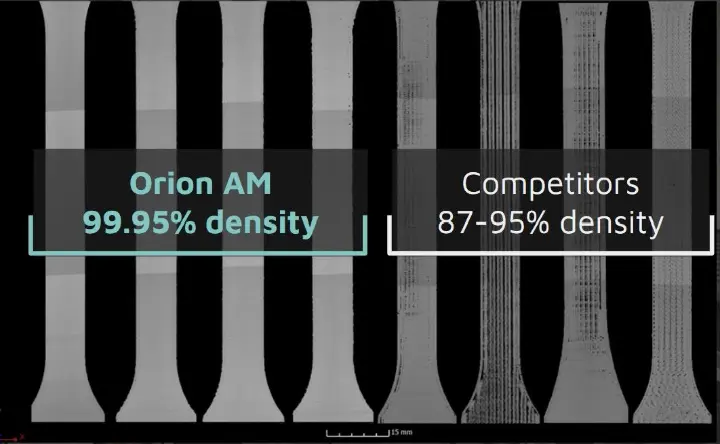
Because convective air cannot deliver targeted thermal energy directly to the exact point where bonding occurs, the interface fails to maintain the energy required for successive filament layers to fully fuse. This results in incomplete interlayer bonding, internal voids within planar layers, and significant mechanical anisotropy. Comparative micro-CT analyses of printed samples indicate that parts produced via conventional ambient heating processes often exhibit internal voids, resulting in relative densities between 87% and 95%, leaving a high void content that compromises Z-axis performance.
The Radiative Alternative: Radiative Heating vs Hot Air Convection 3D Printing
To eliminate the voids and thermal delamination inherent in ambient air systems, the delivery of thermal energy must change. When evaluating radiative heating vs hot air convection 3D printing, the difference lies in how thermal energy is transferred to the polymer.
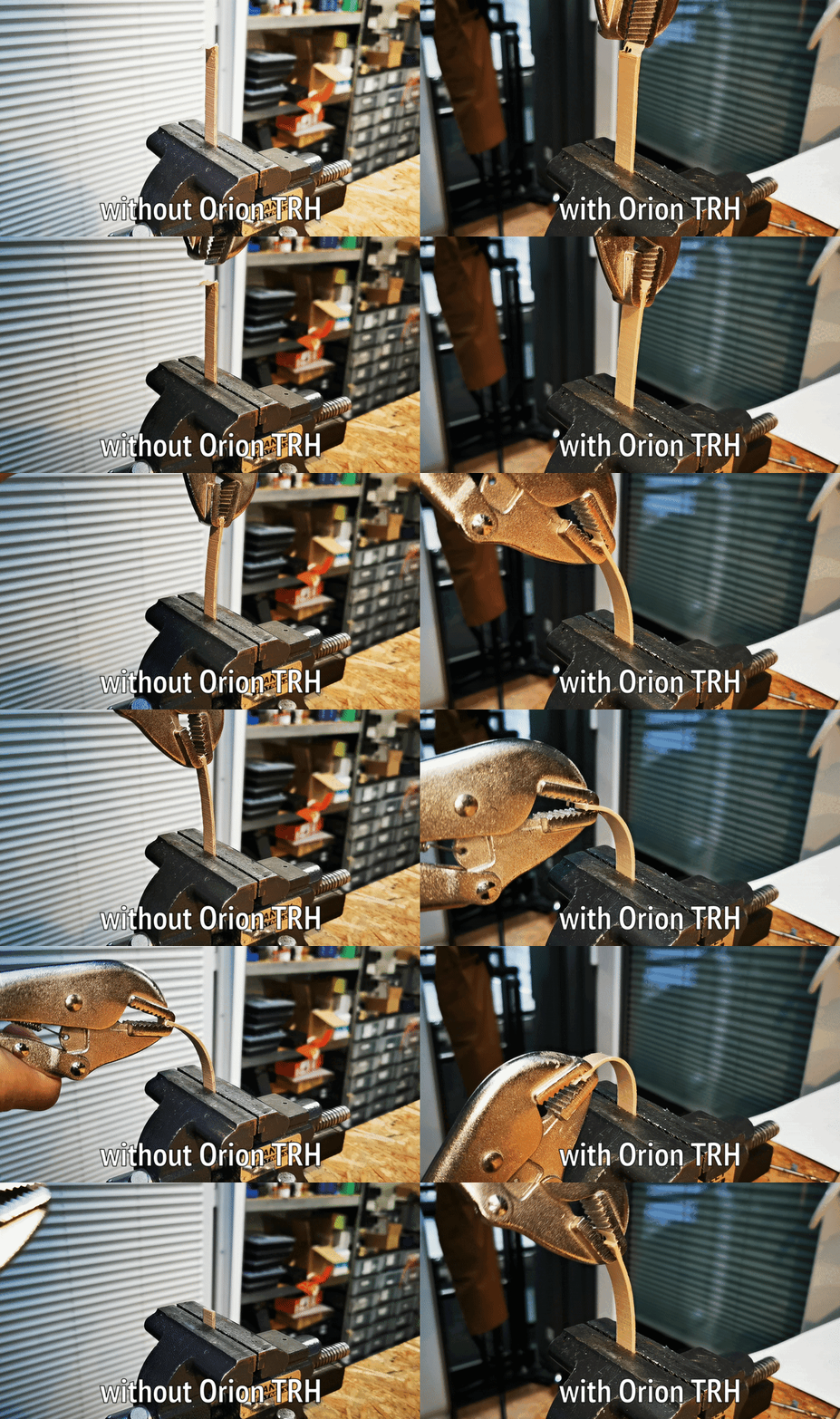
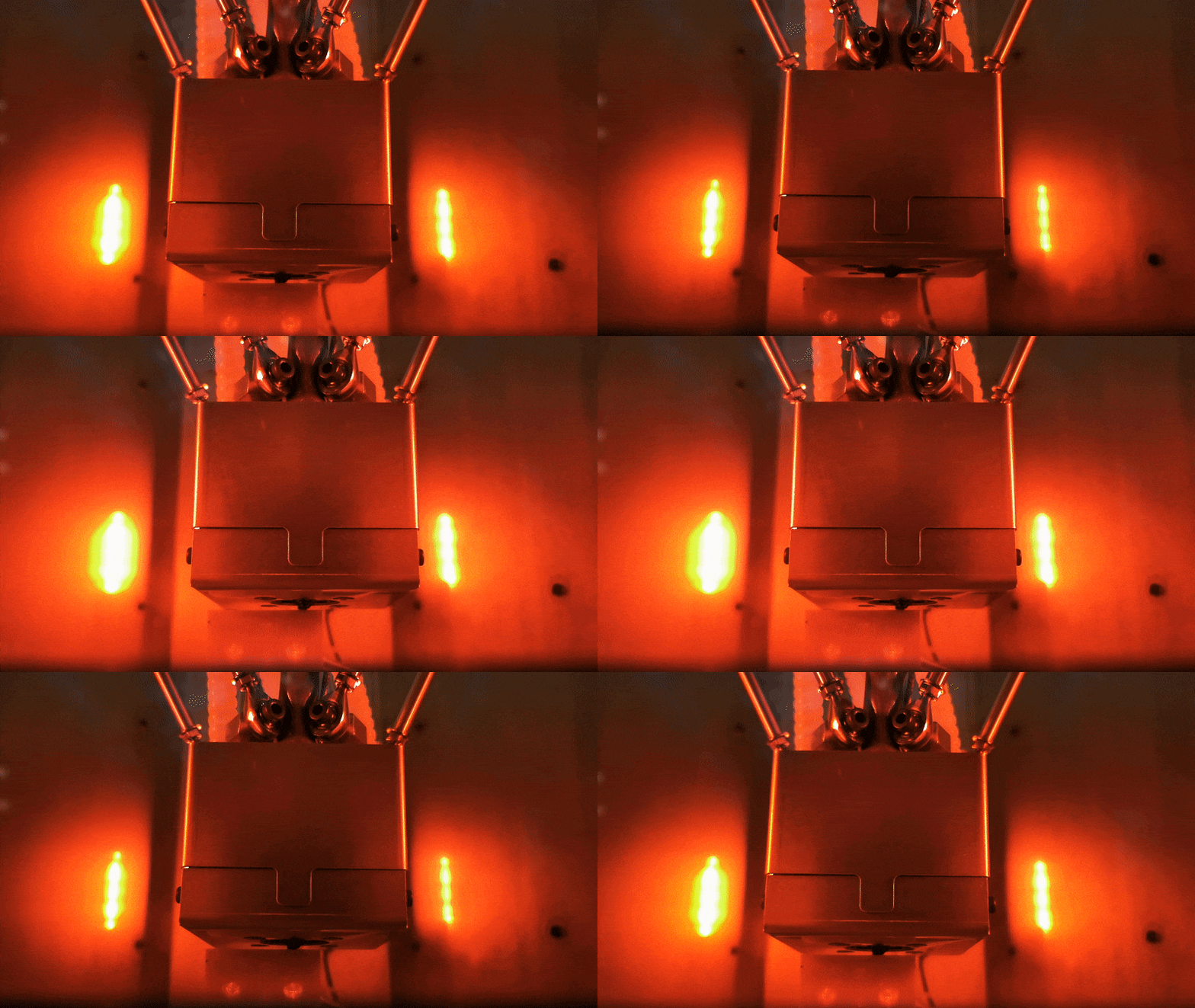
Orion AM’s proprietary Thermal Radiation Heating (TRH) process replaces ambient air circulation with a thermal management strategy combining both unfocused thermal radiation and focused heating to maintain precise thermal stability across the part geometry without relying on high-velocity air movement.
By directing infrared radiation that penetrates directly to the bonding interface, the surface temperature of the underlying layer is raised to its optimal fusion state precisely as the new bead is laid down. This precise energy delivery offsets the thermal gradients caused by air currents and prevents the surface heat loss that leads to cold joints.
In-Situ Semi-Crystallization and Isotropy in PEEK 3D Printing
For semi-crystalline polymers like PEEK, thermal history dictates both molecular alignment and mechanical strength. Proper thermal management during printing ensures that polymer chains have the necessary thermal energy to crystallize uniformly across layer boundaries.
By utilizing TRH, Orion AM high-temperature 3D Printers achieve three critical material outcomes:
- Near-100% Relative Density: Targeted radiation fuses print lines and layers into a homogeneous structure, achieving a relative density of up to 99.95% (a void content as low as 0.05%), validated by independent third parties.
- In-Situ Interlayer Crystallization: The precise application of high temperature facilitates the crystallization of PEEK (between and within layers) during the print, entirely eliminating the need for post-print annealing or heat treatment steps.
- Near-Isotropic Tensile Strength: Because inter-layer bonds match the strength of the extruded material itself, the infill angle and print orientation no longer dictate part strength.
Validated Mechanical Performance (TRH Process)
Independent testing across various commercial PEEK filaments demonstrates that TRH enables vertical (ZX) tensile strength to match or exceed injection molding benchmarks:
- Evonik INFINAM® PEEK 9359F: Achieves 97.2 MPa tensile strength in the vertical (ZX) orientation (compared to a 90 MPa injection molding reference value).
- Solvay KetaSpire® PEEK: Achieves 95.4 MPa tensile strength in the vertical (ZX) orientation (compared to a 91 MPa injection molding reference value).
- Victrex AM™ 450FIL: Achieves 93.3 MPa tensile strength in the vertical (ZX) orientation (compared to a 98 MPa injection molding reference value).
- Invibio PEEK-OPTIMA® LT1: Achieves 92.1 MPa tensile strength in the vertical (ZX) orientation (compared to a 100 MPa injection molding reference value).
Conclusion
Attempting to process high-temperature semi-crystalline polymers using ambient hot air convection forces engineers to accept structural trade-offs in part orientation, density, and Z-axis strength. By shifting from convective ambient air heating to targeted Thermal Radiation Heating, parts achieve up to 99.95% relative density, in-situ semi-crystallization, and near-isotropic performance directly off the build plate.